How to Choose the Right Hazardous Area LED Lighting Range for Gas and Dust Zones
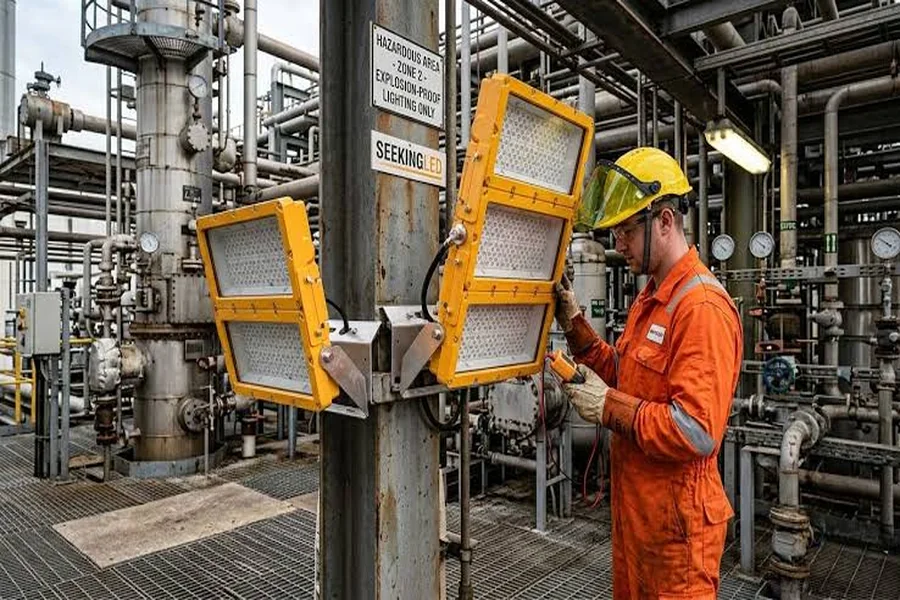
Choosing the right fitting comes down to four checks: your zone classification, the gas or dust group on site, the temperature class of the luminaire, and the certification marking on its label. Match all four to your area classification report and you will end up with a light that is safe and compliant. Miss one, and you could be installing a fitting that cannot contain an ignition source.
It sounds simple, but plenty of people get caught out because a rugged looking light is not the same as a certified one. Before you compare any hazardous area LED lighting range, get your site’s hazardous area classification documents on the desk, since every other decision flows from them.
This guide covers zones, markings, ratings and installation in plain language, the way an experienced electrician would walk you through it on site.
How Do You Choose the Right Fitting?
Confirm your zone (0, 1 or 2 for gas, 20, 21 or 22 for dust), identify the gas or dust group, and make sure the fitting’s maximum surface temperature stays below the ignition temperature of the substance. Then check for IECEx certification and an IP rating that suits the conditions.
What Are Gas and Dust Zones?
A hazardous area is any place where flammable gas, vapour or combustible dust can collect in quantities big enough to ignite. Zones describe how likely that atmosphere is and how long it lasts, and they decide what type of protection a light needs.
Gas Zones (0, 1 and 2)
Zone 0 means an explosive gas atmosphere is present continuously or for long periods, such as inside a tank. Zone 1 means it is likely during normal operation. Zone 2 means it is unlikely, and if it does occur it is brief. Reputable suppliers such as MineGlow state the approved zones on every fitting, so read the label against your classification before you order.
When selecting LED lighting for gas zones, look at the gas group as well. Group IIA covers gases such as propane, IIB covers ethylene, and IIC covers hydrogen and acetylene, which ignite most easily. A fitting approved for IIC can be used for IIA and IIB, but it does not work the other way around.
Dust Zones (20, 21 and 22)
Dust zones follow the same logic. Zone 20 has a dust cloud present continuously or for long periods, Zone 21 is likely during normal operation, and Zone 22 is unlikely and brief. Dust brings an extra problem, because layers settling on a hot fitting can smoulder, so surface temperature matters even more. Dust groups are IIIA for combustible flyings, IIIB for non-conductive dust and IIIC for conductive dust.
Markings and Protection Methods Explained
Every certified fitting carries a marking that tells you what it can do. A typical label might read Ex db IIC T4 Gb. Reading left to right, it gives the protection method, the gas group, the temperature class and the equipment protection level. Here are the common protection methods in practice:
| Marking | What it means | Typical zones |
| Ex d | Flameproof enclosure that contains an internal explosion | Gas Zones 1 and 2 |
| Ex e | Increased safety, built to avoid sparks and hot spots | Gas Zones 1 and 2 |
| Ex ec | Non-sparking, so normal operation will not ignite gas | Gas Zone 2 |
| Ex t | Sealed, temperature limited enclosure for dust | Dust Zones 20, 21 or 22, depending on level |
Temperature Class
Temperature class is the maximum surface temperature a fitting can reach, rated from T1 (450 degrees Celsius) down to T6 (85 degrees Celsius). Choose a class that keeps the surface comfortably below the ignition temperature of the gas or dust on site.
IP Rating
An IP rating covers dust and water ingress only. It does not make a fitting explosion protected. IP66 suits dusty and washdown areas, but a light with IP66 and no Ex marking is not approved for a hazardous zone.
How to Select the Right Fitting Step by Step
- Get the area classification report and confirm every zone on site.
- Note the gas or dust group and the ignition temperature of each substance present.
- Choose a protection method that suits the zone, such as Ex d, Ex e, Ex ec or Ex t.
- Check the paperwork. Genuine hazardous location LED lights carry an IECEx certificate and meet the AS/NZS 60079 series.
- Match brightness, beam spread and mounting height to the task being done.
- Have a competent person install it to AS/NZS 60079.14 and keep the records.
Matching the Fitting to the Environment
Industrial hazardous area lighting has to cope with more than explosive atmospheres. Fuel depots, mines, grain facilities, chemical plants and paint booths all deal with vibration, washdown, heat or salty air. Marine grade aluminium and stainless steel bodies hold up well against corrosion, and tempered glass or impact resistant polycarbonate lenses handle knocks.
LED suits this work well. LEDs run cooler than older discharge lamps, last far longer and switch on instantly, which means fewer lamp changes at height in dangerous areas. Good hazardous area lighting solutions also control glare and offer emergency backup versions where losing light creates a safety risk.
Cable entries deserve attention too. Glands and blanking plugs must carry their own Ex certification, because an uncertified gland can undo the protection of an otherwise compliant light.
Common Mistakes to Avoid
- Treating an IP rating as proof of explosion protection.
- Swapping in a similar looking fitting during maintenance.
- Ignoring temperature class where dust layers can build up.
- Using uncertified glands or modifying the enclosure.
- Skipping inspection records after installation.
Frequently Asked Questions
1. What is the difference between Zone 1 and Zone 2 lighting?
Zone 1 fittings suit areas where explosive gas is likely during normal operation, so they need stronger protection such as Ex d or Ex e. Zone 2 fittings suit areas where gas is unlikely and brief, so Ex ec is often enough. A Zone 1 fitting can also be used in Zone 2.
2. Can I use a standard IP66 LED light in a hazardous area?
No. IP66 only covers dust and water ingress. A fitting must carry an Ex marking and certification that matches your zone.
3. What does Ex d mean on a light fitting?
Ex d stands for flameproof enclosure. The strong housing contains any internal explosion and cools escaping gases so they cannot ignite the atmosphere outside.
4. Which certification should I look for in Australia?
Look for an IECEx certificate with the fitting meeting the AS/NZS 60079 series. Many products also hold ATEX, but IECEx is the common pathway here.
5. Why does temperature class matter?
A hot surface can ignite gas or dust on its own. The temperature class must sit below the ignition temperature of the substance, with a safety margin.
6. How often should hazardous area lights be inspected?
Inspect after installation, then at intervals set by a competent person under AS/NZS 60079.17, based on site conditions and risk.
Final Thoughts
Getting this right protects people, plants and production. Start with your zone classification, confirm the gas or dust group and temperature class, and insist on proper certification. MineGlow is a trusted name for Australian sites that need certified LED fittings for gas and dust zones, and the team can help match a fitting to your classification report.
Unsure which fitting suits your zone? Send your classification details across and check the specifications against the points above before you commit.